
How do bio-based raw materials become market-ready solutions? At the Bioeconomy Austria Summit on 5 October 2026 at Seifenfabrik Graz, companies, researchers, start-ups and regions from across Austria came together. The focus was on new data on the bioeconomy, concrete business models, financing, and what is needed to take the next step to market.
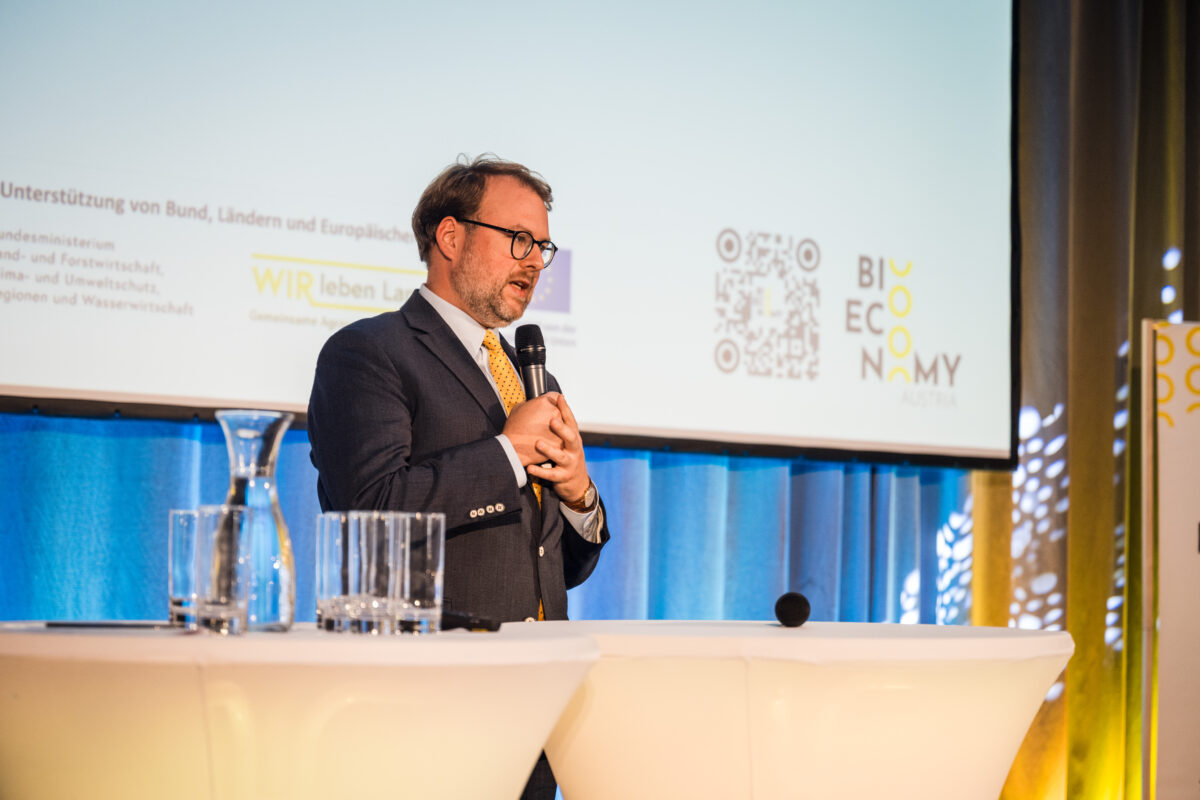
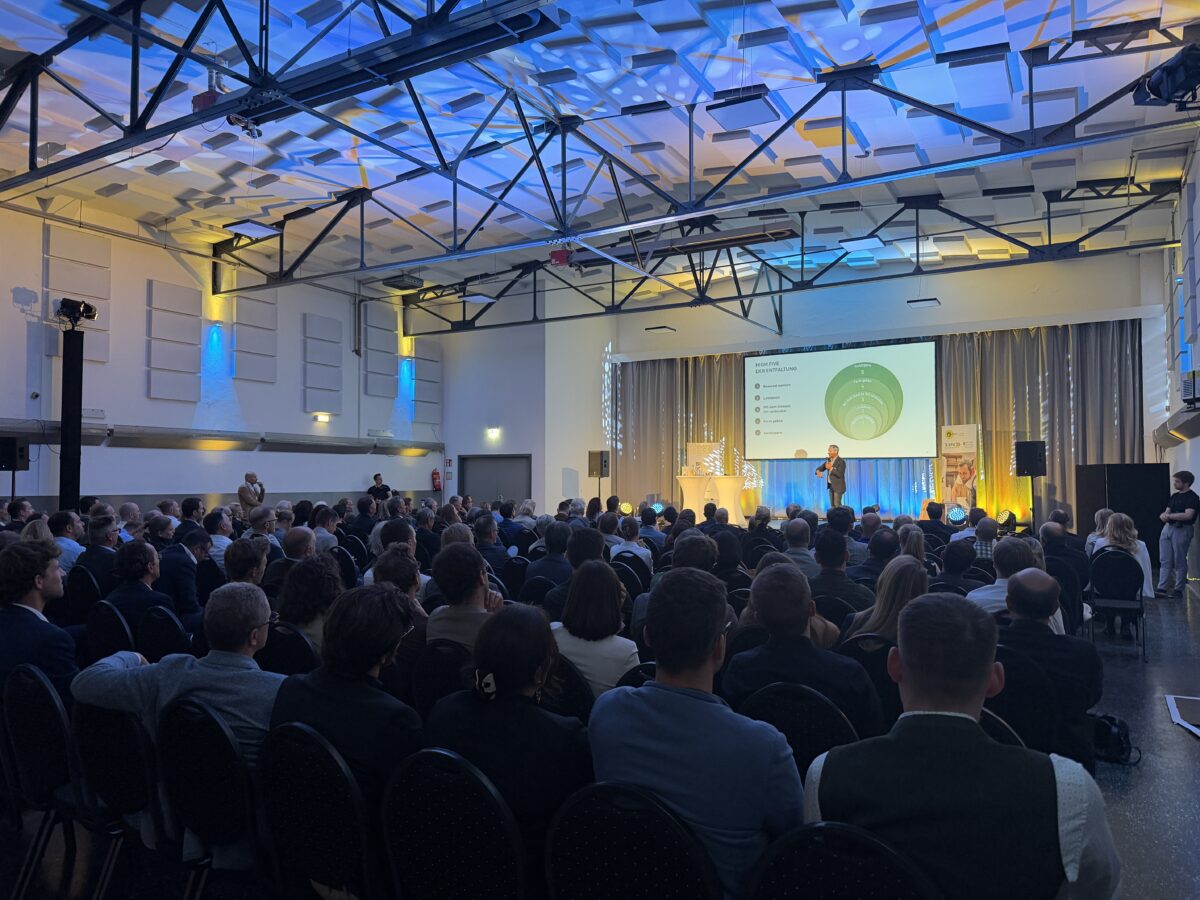
The event opened with welcoming remarks by Georg Rappold (BMLUK, Department III/5 – Wood Policy, Bioeconomy and Innovation) and the evening’s moderator, Stephanie Bürgler.
€166 billion: Austria’s first Bioeconomy Yearbook
Austria’s first Bioeconomy Yearbook “EinBlick” shows just how significant the bioeconomy is in Austria: €166 billion in revenue, 395,000 employees and 43,600 companies. This means that one in every ten euros of Austria’s total economic output is generated by the bioeconomy. Thomas Timmel, Managing Director of BioBASE, presented the publication at the Summit. For the first time, all bio-based value chains were mapped, from agriculture and forestry through processing and trade to energy production, with a particular focus on Austria’s federal states.
Austria builds with wood – or does it?
Andreas Ringhofer, Managing Director of holz.bau forschungs gmbh in Graz, questioned the title of his own presentation right from the start: at present, he said, it cannot quite be endorsed, as timber construction is currently showing little growth in Austria. Nevertheless, the future potential remains considerable, particularly in the existing building stock. Vertical extensions and infill development using timber construction can create additional housing without sealing new land, while storing carbon for decades. According to the yearbook, wood and paper already account for more than €30 billion in revenue in Austria.
From pitch to market: six ideas in twenty minutes
The path from innovative ideas to market was given particular emphasis. Five start-ups from the Tech Tour Forest Bioeconomy and one team from the BIOEAST Students Challenge pitched their solutions: lamps made from used cooking oil (VitraLux), AI-powered analyses for circular product design (aitark), peat-free plant substrates made from cellulose fibres (FibriTech), automated joining of plastics with wood or metal (royos), a satellite-based app providing up-to-date insights into forest areas (WoodsApp), and automated, decentralised mushroom farms (SpawnX).
On stage were Simon Rauscher (aitark), Tomasz Ciamulski (FibriTech), Mario Leitner (royos), Valentin Streif (WoodsApp), Vladimir Kaverin (SpawnX), as well as the VitraLux team Anna Rezija Aboltina, Daniela Kūla and Ričards Varens.
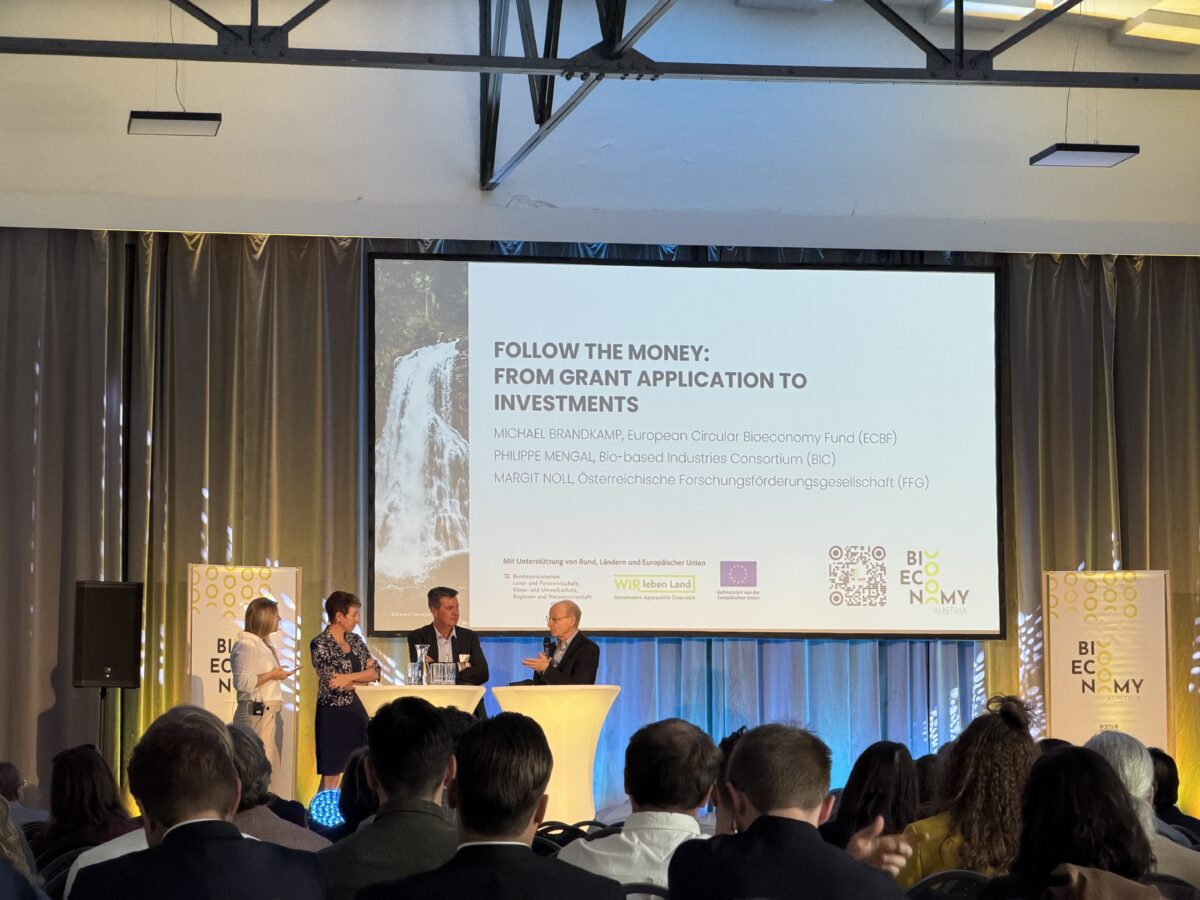
Follow the Money: From Application to Investment
Many ideas stall between a funded research project and the first industrial-scale plant. How this “Valley of Death” can be bridged was discussed by Michael Brandkamp (European Circular Bioeconomy Fund), Philippe Mengal (Bio-based Industries Consortium) and Margit Noll (FFG). The discussion focused on how public funding, private capital and industry partners can work together more effectively so that successful projects can scale.
“Austrian companies are above average in terms of success in European bioeconomy programmes. The challenge begins afterwards: bridging the gap between a funded project and industrial production requires capital on a scale that neither public funding nor banks can provide on their own. Closing this gap is a shared task for national funding bodies and European investors,” said Margit Noll, Head of European and International Programmes at FFG.
Bioeconomy in practice: Forestry, Agriculture and Aqua
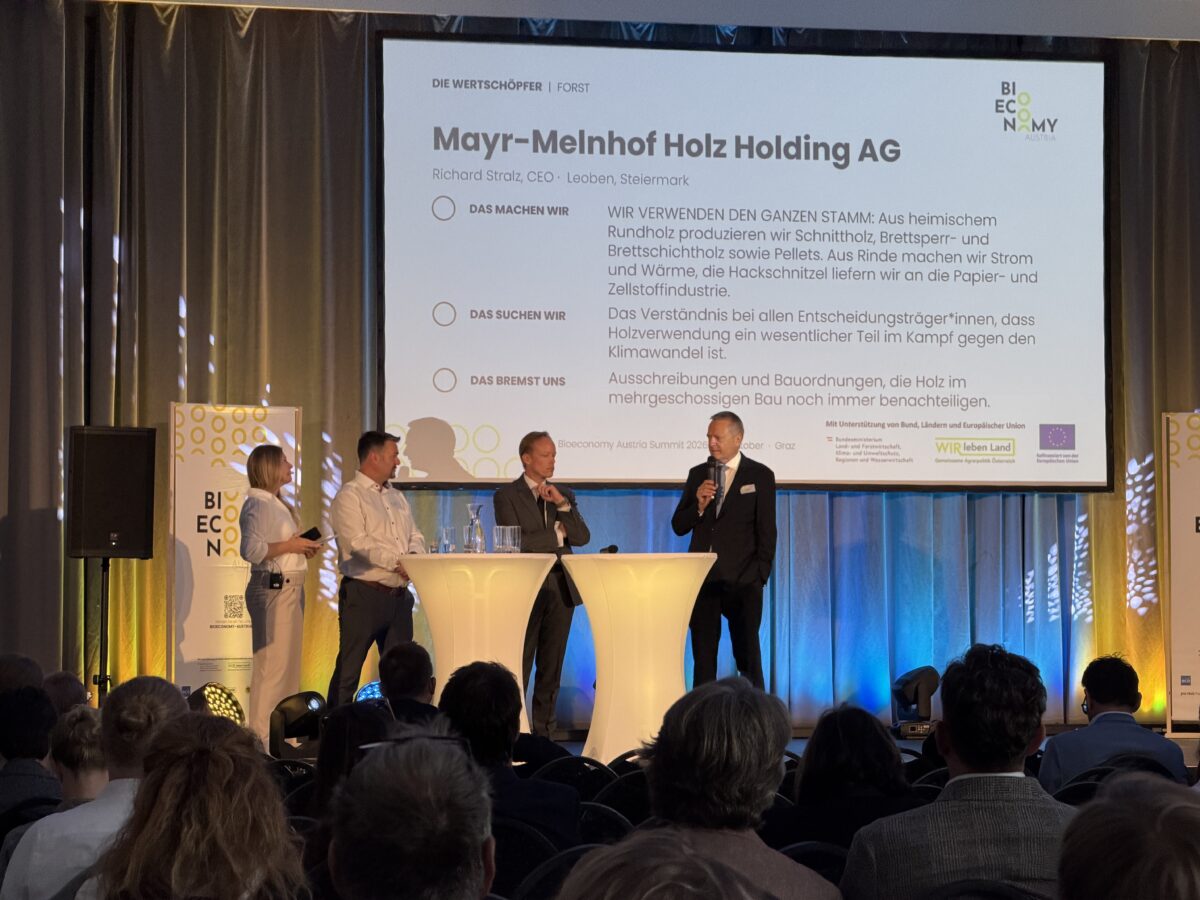
Nine companies in the Bioeconomy Industry Talks showed how broadly the bioeconomy is already being put into practice. Examples ranged from wood-gas power plants and cross-laminated timber for multi-storey construction to insect protein made from food residues, Styrian pumpkin-seed products and a biorefinery that produces starch, protein and bioethanol from wheat.
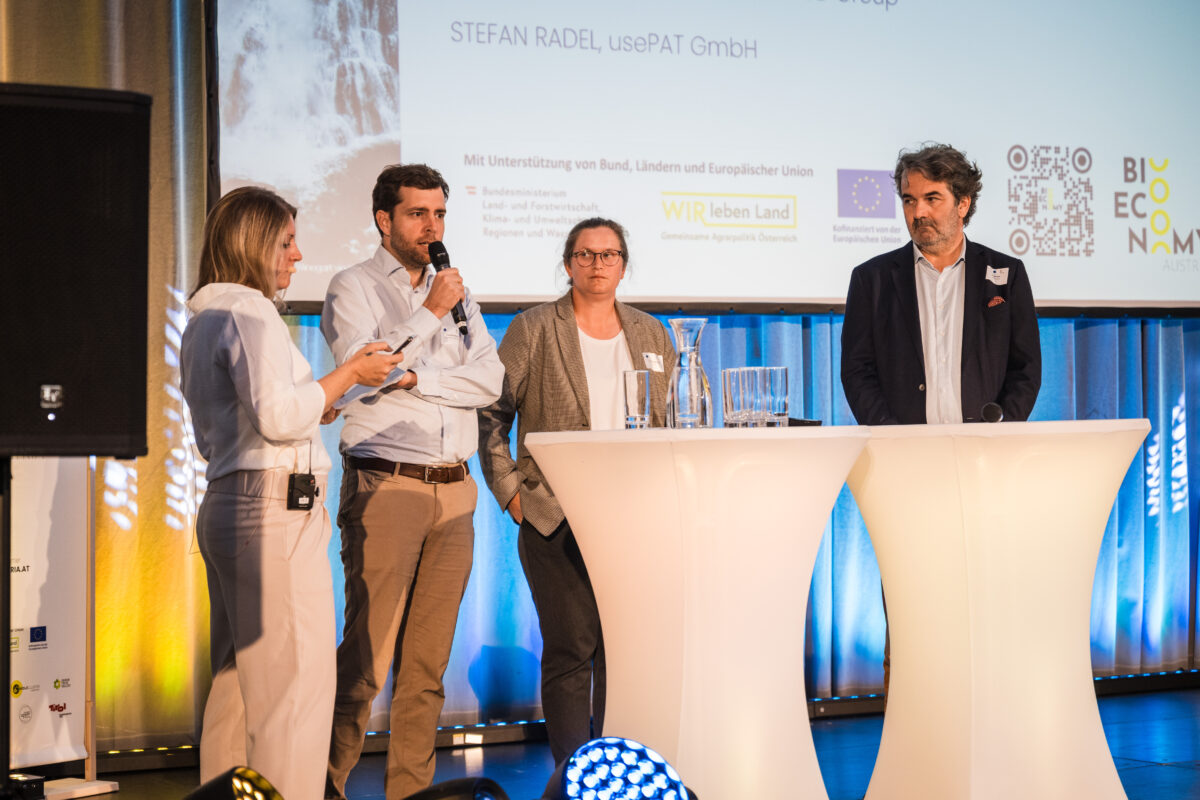
The Forestry segment featured Marcel Huber (Syncraft GmbH), Hubertus Burger-Scheidlin (Fundermax GmbH) and Richard Stralz (Mayr-Melnhof Holz Holding AG); Agriculture was represented by Gernot Beutle (Reploid Group AG), Andreas Cretnik (Estyria Naturprodukte GmbH) and Robert Schöggl (AGRANA Beteiligungs AG); Aqua by Paul Schmitzberger (Blue Planet Ecosystems GmbH), Ricarda Kriechbaum (TU Wien – IBD Group) and Stefan Radel (usePAT GmbH). The discussion covered not only what is already on the market, but also which partners are needed for the next steps and which barriers are currently slowing innovation.
The Marketplace: networking and new ideas
After the Bioeconomy Industry Talks, the format shifted from the stage to direct exchange. At three thematic hubs for Forestry, Agriculture and Aqua, participants, companies and start-ups came together. Guided by the questions “What I offer”, “What I am looking for” and “What is holding me back”, they discussed current challenges, opportunities for collaboration and possible solutions. At each station, participants could capture ideas, discussion outcomes and thoughts on posters dedicated to the three questions. In addition, 11 companies and start-ups, most of them from the Industry Talks and pitch sessions, showcased their products, prototypes and materials. This gave participants a first-hand look at concrete bio-based solutions.
Two days of bioeconomy in Graz
The Summit was not a stand-alone event in 2026. The Tech Tour Forest Bioeconomy brought together 24 selected start-ups and scale-ups from across Europe with more than 30 international investors on 5 and 6 October. This year, Bioeconomy Austria, together with Holzcluster Steiermark and the EFI Bioregions Facility, hosted the event. This year Pitch sessions, structured one-to-one meetings and exchanges with industry partners fostered collaboration and investment in the forest-based bioeconomy.
Immediately after the Summit, Bioeconomy Austria partner Holzcluster Steiermark celebrated its 25th anniversary together with partner companies, long-standing companions, and representatives from business, research and politics. Since 2001, the cluster has connected companies, research organisations and institutions along the wood value chain.
New Impetus, Strong Connections
The Bioeconomy Austria Summit 2026 showcased the bioeconomy across its entire development pathway: from data and new technologies to established business models, financing and cooperation. What matters is turning good ideas into market-ready solutions and contacts into concrete collaboration.
We would like to thank all speakers, companies, pitch teams and exhibitors for their contributions, Holzcluster Steiermark for its hospitality in Graz, and Tech Tour Forest Bioeconomy and the EFI Bioregions Facility for the excellent cooperation.
Become a network partner now and join us at the Bioeconomy Austria Summit 2027!
© ms moving stills
© Bioeconomy Austria
© ms moving stills
© Bioeconomy Austria